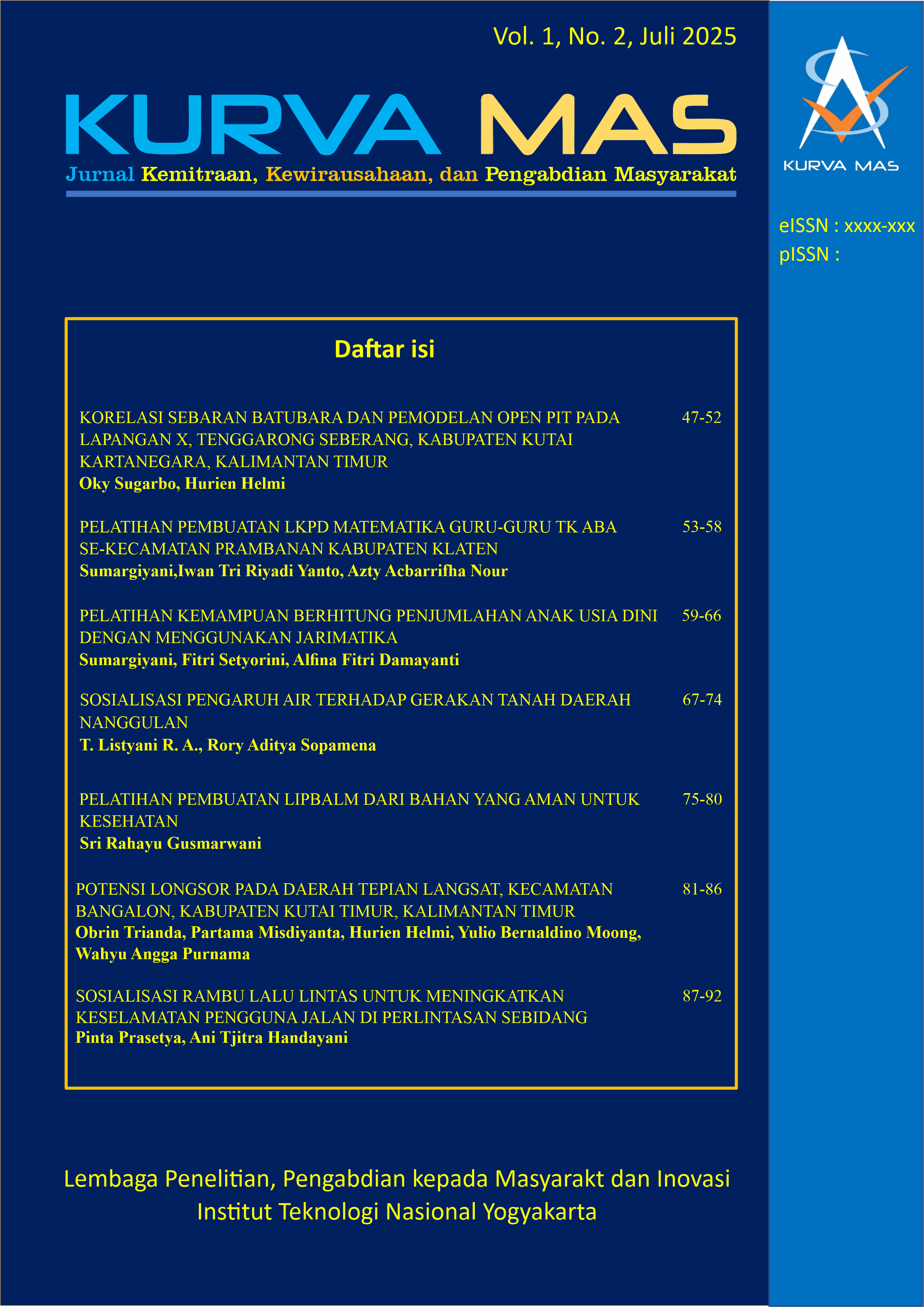
Training on Making Lip Balm from Ingredients that are Safe for Health
DOI:
https://doi.org/10.33579/krvms.v1i2.5826Keywords:
Lipbalm, bahan alamiAbstract
Awareness increasing of health and environmental sustainability is the background to the choice of natural lip balm which is certainly healthier and more responsible for users. Hazardous chemicals that used in cosmetic products were still not widely understood by the public, so it was necessary to socialize the use of chemicals that were safe for health as well as how to make them. Natural lip balm was needed for several main reasons, including: safety and health, naturally moisturizing, avoiding the risk of allergies and irritation, environmentally friendly, additional nutrition for the lips, does not contain toxic ingredients. Lip balm training activity was carried out as part of community service activities that are members of the GaGeGo Organic (3GO) community in Pati Regency, Central Java. The benchmark for the success of the activity could be seen from the number of participants who attended, the questions asked, and the activeness of participants during the lecture (explanation) and practice. The questions were grouped into 5, namely: The importance of natural lip balm and its effects on the user's body, lip balm ingredients, equipment, manufacturing methods, and economic calculations for sales. The challenge experienced during the implementation of the service was the duration of the training time was too short so that the explanation was done while practicing.
References
Brown, A., “Natural Beauty: The Complete Guide to Organic Skincare and Natural Remedies”, Green Press, 2018
Smith, J., “The Science of Natural Cosmetics: Understanding Ingredients and Their Benefits”, Nature Publishing, 2020
Williams, L. , “DIY Organic Beauty: Homemade Recipes for Skincare and Haircare”, Eco Living Books, 2019
Zhang, Y., “Sustainable Cosmetics: Innovations in Natural and Eco-Friendly Beauty Products”, Global Science Press, 2021
Downloads
Published
Issue
Section
License
Copyright (c) 2025 Sri Rahayu Gusmarwani

This work is licensed under a Creative Commons Attribution-NonCommercial-ShareAlike 4.0 International License.
Jurnal ini menyediakan akses terbuka langsung mengenai kontennya dengan prinsip bahwa pengabdi disediakan secara gratis untuk umum mendukung pertukaran pengetahuan global yang lebih besar.
Semua artikel yang diterbitkan dalam Akses Terbuka akan segera dan gratis secara permanen untuk dibaca dan diunduh oleh semua orang. Kami terus bekerja dengan komunitas penulis untuk memilih pilihan lisensi terbaik, yang saat ini didefinisikan untuk jurnal ini sebagai berikut:
• Creative Commons Attribution-ShareAlike (CC BY-SA)

This work is licensed under a Creative Commons Attribution-ShareAlike 4.0 International License.