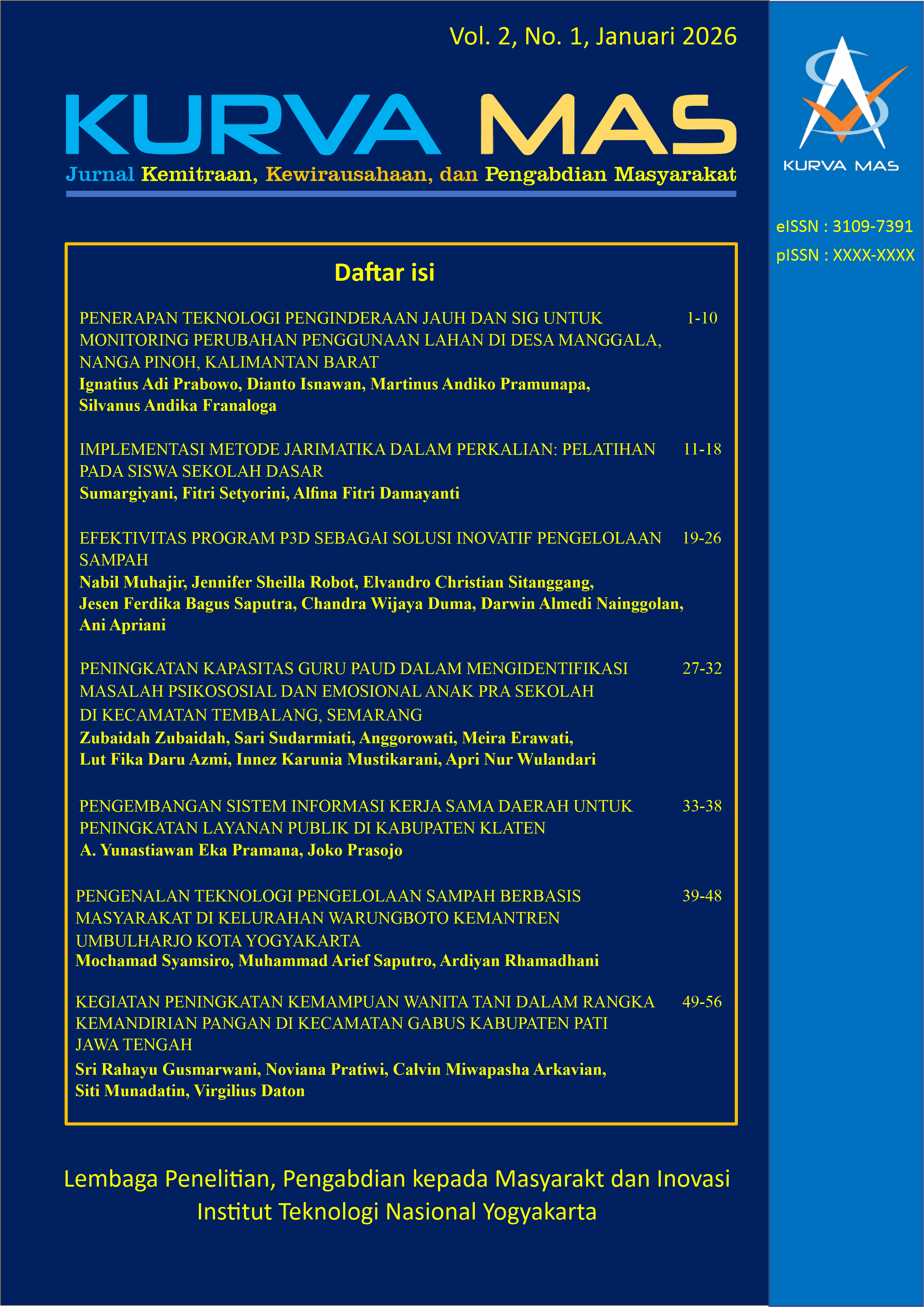
PENINGKATAN KAPASITAS GURU PAUD DALAM MENGIDENTIFIKASI MASALAH PSIKOSOSIAL DAN EMOSIONAL ANAK PRA SEKOLAH DI KECAMATAN TEMBALANG, SEMARANG
DOI:
https://doi.org/10.33579/krvms.v2i1.6342Keywords:
psychosocial problems in children, emotional problems in children, early childhood education (PAUD)Abstract
Background: The psychosocial developmental stage of preschool-aged children is Initiative vs. Guilt. Early childhood education (PAUD) teachers in the Wisnu Cluster, Tembalang Subdistrict, experience difficulties in distinguishing children with psychosocial and emotional developmental problems. As a result, these issues often go undetected and untreated. Objective: To improve teachers’ knowledge and skills in identifying and conducting early detection of psychosocial and emotional developmental problems among preschool-aged children in Tembalang Subdistrict, Semarang City. Methods: This community service activity involved 40 PAUD teachers in Tembalang Subdistrict, Semarang City. The teachers participated in a short training session on recognizing psychosocial and emotional problems in students. The training methods included discussions, lectures, demonstrations, practical exercises, and supervision. The second activity was a parenting class on managing tantrums, attended by 30 parents of the students. Results: The results of this program showed an increase in the knowledge and skills of teachers in the Wisnu Cluster, Tembalang, in accurately recognizing psychosocial and emotional problems in children as an effort for early detection. Teachers also learned how to respond appropriately and provide guidance using the asah, asih, asuh (stimulate, love, nurture) approach for children with psychosocial problems. Furthermore, parents gained the ability to manage tantrums in preschool-aged children. Conclusion: This community service activity improved teachers’ ability to perform early detection of psychosocial and emotional problems in children, allowing early identification before these issues become more complex. It also provided parents with effective strategies to manage tantrum behavior in preschoolers.
References
Erikson E. Childhood and society. In Yogyakarta: Pustaka Pelajar; 2010
Mutia D. Psikologi bermain anak usia dini. In Jakarta: Kencana Prenada Media Group; 2010.
Nuryanti I. Meningkatkan kemampuan sosial Psikososial dan emosional anak usia dini kelompok b dengan model cooperative learning di RA An-Nuur Dusun Tanjung Agung. 2022;2(1):118–42.
Dikdasmen Kota Semarang. Data peserta didik tahun 2024. Data Peserta Didik Kec. Tembalang - Dapodikdasmen. Diakses pada Tanggal 10 Maret 2025
Magdalena I, Nurul Annisa M, Ragin G, Rahmah Ishaq A. Analisis penggunaan teknik Pre-Test dan Post-Test pada mata pelajaran matematika dalam keberhasilan evaluasi pembelajaran di SDN Bojong 04. Jurnal Pendidikan Dan Ilmu Sosial. 2024;3(2).
Sofyandi, H. Manajemen Sumber Daya Manusia (Pertama ed., Vol. Cetakan Pertama). Yogyakarta: Graha Ilmu; 2013.
Elya, N. Kajian Faktor yang Mempengaruhi Retensi Siswa Analisis Hasil Penelitian Eksperiman dan PTK. Prosiding. 2015.
Arikunto, S. (2019). Dasar-Dasar Evaluasi Pendidikan. Jakarta: Bumi Aksara.
Baddeley, A. (2012). Working Memory: Theories, Models, and Controversies. Annual Review of Psychology, 63(1), 1–29.
Fauzan, M., & Suryani, L. (2020). Faktor yang Mempengaruhi Keberhasilan Pelatihan Guru. Jurnal Pendidikan, 21(3), 145–152.
Guskey, T. R. (2002). Professional Development and Teacher Change. Teachers and Teaching, 8(3), 381–391.
Joyce, B., & Showers, B. (2002). Student Achievement through Staff Development. ASCD.
Kirkpatrick, D. L. (1994). Evaluating Training Programs: The Four Levels. Berrett-Koehler.
Roediger, H. L., & Butler, A. C. (2011). The Critical Role of Retrieval Practice in Long-Term Retention. Trends in Cognitive Sciences, 15(1), 20–27.
Sudjana, N. (2016). Penilaian Hasil Proses Belajar Mengajar. Bandung: Remaja Rosdakarya.
Susanti, E., & Rahayu, D. (2021). Pengaruh Pelatihan terhadap Peningkatan Kompetensi Guru PAUD. Jurnal Obsesi: Jurnal Pendidikan Anak Usia Dini, 5(2), 1881–1892.
Downloads
Published
Issue
Section
License
Copyright (c) 2026 Zubaidah Zubaidah, Sari Sudarmiati, Anggorowati

This work is licensed under a Creative Commons Attribution-NonCommercial-ShareAlike 4.0 International License.
Jurnal ini menyediakan akses terbuka langsung mengenai kontennya dengan prinsip bahwa pengabdi disediakan secara gratis untuk umum mendukung pertukaran pengetahuan global yang lebih besar.
Semua artikel yang diterbitkan dalam Akses Terbuka akan segera dan gratis secara permanen untuk dibaca dan diunduh oleh semua orang. Kami terus bekerja dengan komunitas penulis untuk memilih pilihan lisensi terbaik, yang saat ini didefinisikan untuk jurnal ini sebagai berikut:
• Creative Commons Attribution-ShareAlike (CC BY-SA)

This work is licensed under a Creative Commons Attribution-ShareAlike 4.0 International License.