THE ROLE OF LANSAT 8 OLI/TIRS SATELLITE IMAGERY IN ANALYZING GROUNDWATER RECHANGE AREAS IN MAGELANG REGENCY, CENTRAL JAVA
Keywords:
groundwater recharge potential, Magelang, Geographic Information System, Landsat 8 OLI/TIRS, water conservationAbstract
This study aims to analyze the distribution of groundwater recharge potential areas in Magelang Regency using a Geographic Information System (GIS) approach and Landsat 8 OLI satellite imagery. The analysis was conducted by integrating four key parameters: land cover, soil type, slope gradient, and rainfall, utilizing a scoring and overlay method. Supporting data such as the National Digital Elevation Model (DEMNAS) were used for topographic analysis. Rainfall data were obtained from CHIRPS, while soil type maps were sourced from FAO/UNESCO to support spatial modeling. The results revealed that approximately 27% of the Magelang Regency area has high groundwater recharge potential, 59% falls into the moderate (natural) category, and 14% is classified as critical to highly critical. Areas with high recharge potential are generally characterized by dense vegetation cover, highly porous soils, and relatively gentle to moderate slopes. In contrast, areas with low recharge potential are commonly found in built-up regions and steep slopes that are prone to surface runoff. These findings are expected to provide valuable insights for groundwater conservation planning and sustainable land use management. The implementation of integrated conservation strategies is crucial to enhance soil infiltration capacity and maintain the hydrological cycle balance in Magelang Regency
Downloads
References
T. Listyani and T. T. Putranto, “Studi Potensi Airtanah pada Cekungan Airtanah (CAT) Banyumudal, Kabupaten Kebumen, Jawa Tengah,” J. Ilmu Lingkung., vol. 18, no. 3, pp. 531–544, 2020, doi: 10.14710/jil.18.3.531-544.
B. Sigit, D. Yuliani, and T. Hidayat, “Analisis Potensi Daerah Resapan Air dan Upaya Pengelolaannya di Wilayah Pegunungan,” J. Hidrol. dan Lingkung., vol. 17, no. 4, pp. 233–245, 2020, doi: 10.7890/jhl.v17i4.2020.
P. S. D. Air, Pengelolaan Sumber Daya Air Berkelanjutan di Kabupaten Magelang. Yogyakarta: Pusat Sumber Daya Air, 2019.
R. Salsabiila, E. T. Paripurno, and C. Prasetyadi, “Geological Condition and Landslide Vulnerability Zonation using Frequency Ratio Method in Salaman District, Magelang Regency, Central Java Province,” Ris. Geol. dan Pertamb., vol. 33, no. 2, pp. 99–121, 2023, doi: 10.55981/risetgeotam.2023.1238.
D. Yuliani, B. Sigit, and E. Ningsih, “Pengaruh Konversi Lahan terhadap Kualitas Daerah Resapan Air di Kabupaten Magelang,” J. Ekol. dan Konserv. Alam, vol. 5, no. 2, pp. 145–158, 2017, doi: 10.4567/jeka.v5i2.2017.
A. Kusumastuti and D. Rahmawati, “Pemodelan Daerah Resapan Air Menggunakan Sistem Informasi Geografis (SIG) di Kabupaten Magelang,” J. Sumber Daya Alam, vol. 14, no. 3, pp. 45–59, 2021, doi: 10.1234/jsda.v14i3.2021.
Winarti, “Metode Geolistrik untuk Mendeteksi Akuifer Airtanah di Daerah Sulit Air (Studi Kasus : Kecamatan Takeran, Poncol dan Parang, Kabupaten Magetan),” J. Ilm. Bid. Teknol., vol. 5, no. 1, pp. 1–23, 2013.
K. P. Umum, “Peraturan Menteri Pekerjaan Umum Republik Indonesia Nomor: 02/PRT/M/2013 tentang Pedoman Penyusunan Rencana Pengelolaan Sumber Daya Air,” Kementerian Pekerjaan Umum Republik Indonesia, 2013.
Menteri Kehutanan Republik Indonesia, Peraturan Menteri Kehutanan Republik Indonesia No : P. 32/MENHUT-II/2009, vol. 19, no. 19. 2009.
Wibowo Mardi, “Model Penentuan Kawasan Resapan AirUntuk Perencanaan Tata Ruang BerwawasanLingkungan,” J. Hidrosfir, vol. 1, no. 1, pp. 1–7, 2006.
___, Diklat Calon Competen Person Ahli Estimasi Cadangan Perencanaan Tambanga Jangka Panjang Perencanaan Tambang Jangka Pendek. Bandung, Indonesia, 2024.
A. Prawira, N. Lestari, and I. Handayani, “Strategi Konservasi Daerah Resapan Air untuk Menjaga Ketersediaan Sumber Daya Air,” J. Lingkung. Hidup, vol. 11, no. 2, pp. 112–123, 2022, doi: 10.5678/jlh.v11i2.2022.
W. Sutanto, S. Adi, and P. Pramudito, “Evaluasi dan Strategi Pengelolaan Daerah Resapan Air Di Wilayah Pegunungan,” J. Pengelolaan Sumber Daya Alam, vol. 20, no. 1, pp. 79–93, 2019, doi: 10.3456/jpsda.v20i1.2019.
M. S. Syam’ani ,S. Hut., “How Inverse Distance Weighted (IDW) Works,” ArcGIS 9.2 Deskt. Help, no. 17 Nov, 2007.
Isaaks and Srivastava, “Applied Geostatistics,” 1989.
Yuningsih and A. Wibowo, “Pemetaan Distribusi Curah Hujan menggunakan Data CHIRPS Periode 2013-2023 untuk Evaluasi Zonasi Hutan di Provinsi Banten,” Media Komun. Geogr., vol. 25, no. 2, pp. 293–308, 2024.
C. Dandridge, V. Lakshmi, J. Bolten, and R. Srinivasan, “Evaluation of Satellite-Based Rainfall Estimates in the Lower Mekong River Basin (Southeast Asia),” Remote Sens., vol. 11, no. 22, pp. 1–17, 2019, doi: 10.3390/rs11222709.
D. S. Zees, “Analisis Daerah Resapan Air dan Kesesuaiannya dengan Arahan Pola Ruang melalui Pemanfaatan Sistem Informasi Geografis (SIG) di Kota Gorontalo,” J. Ilmu Komput., vol. 3, no. 2, p. 45, 2023, doi: 10.31314/juik.v3i2.2437.
Khusrizal, N. Oktavia, Muliana, and Nasruddin, “Pedogenesis dan Klasifikasi Tanah Sub-Das Peusangan Hilir Berdasarkan Sistem Klasifikasi Taksonomi Tanah dan Fao-Unesco,” J. Agrium, vol. 19, no. 4, pp. 316–327, 2022.
B. Geologi, Potensi Geologi Daerah Magelang dan Implikasinya terhadap Pengelolaan Sumber Daya Alam. Jakarta: Badan Geologi, 2018.
O. Verdiansyah, “A Desktop Study to Determine Mineralization using Lineament Density Analysis at Kulon Progo Mountains, Yogyakarta and central Java province, Indonesia,” Indones. J. Geogr., vol. 51, no. 1, pp. 31–41, 2019, doi: 10.22146/ijg.37442.
U. A. Said, R. A. Bantan, A. A. Mannaa, and Y. Taufiq, “The Use of Landsat 8 in Detecting Potential Mineral Zones in West Nusa Tenggara, Indonesia,” Russ. J. Earth Sci., vol. 24, no. 5, pp. 1–11, 2024, doi: 10.2205/2024es000921.
B. S. F. D. Hastono dan B. Sudarsono, “Identifikasi Daerah Resapan Air dengan Sistem Informasi Geografis (Studi Kasus: Sub DAS Keduang),” vol. 9, p. 8, 2012, doi: DOI:10.14710/jgundip.2012.2232.
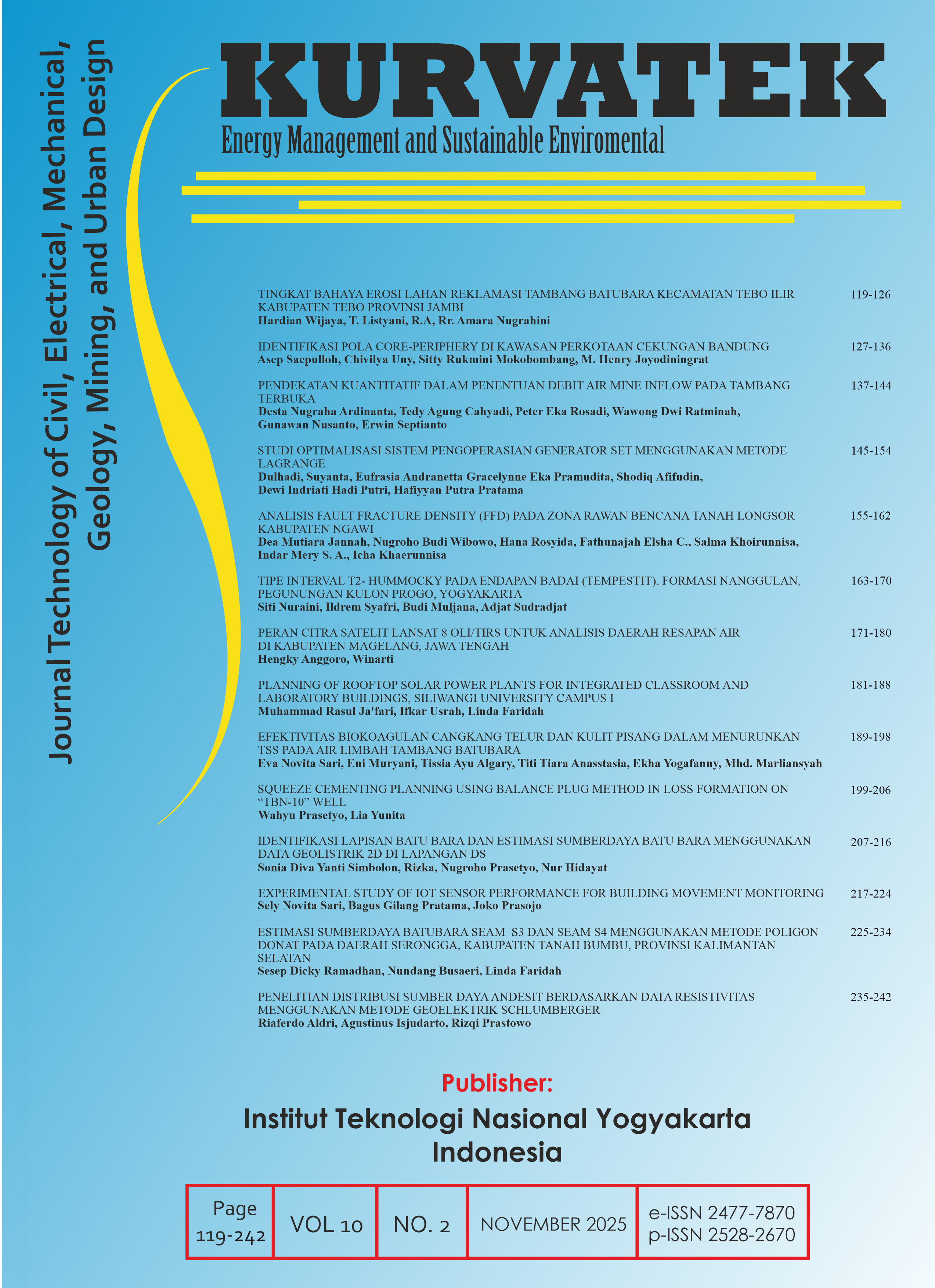
Downloads
Published
How to Cite
Issue
Section
License
Copyright (c) 2025 Hengky Anggoro, Winarti Winarti

This work is licensed under a Creative Commons Attribution-ShareAlike 4.0 International License.
This journal provides immediate open access to its content on the principle that making research freely available to the public supports a greater global exchange of knowledge.
All articles published Open Access will be immediately and permanently free for everyone to read and download. We are continuously working with our author communities to select the best choice of license options, currently being defined for this journal as follows:
• Creative Commons Attribution-ShareAlike (CC BY-SA)

This work is licensed under a Creative Commons Attribution-ShareAlike 4.0 International License.