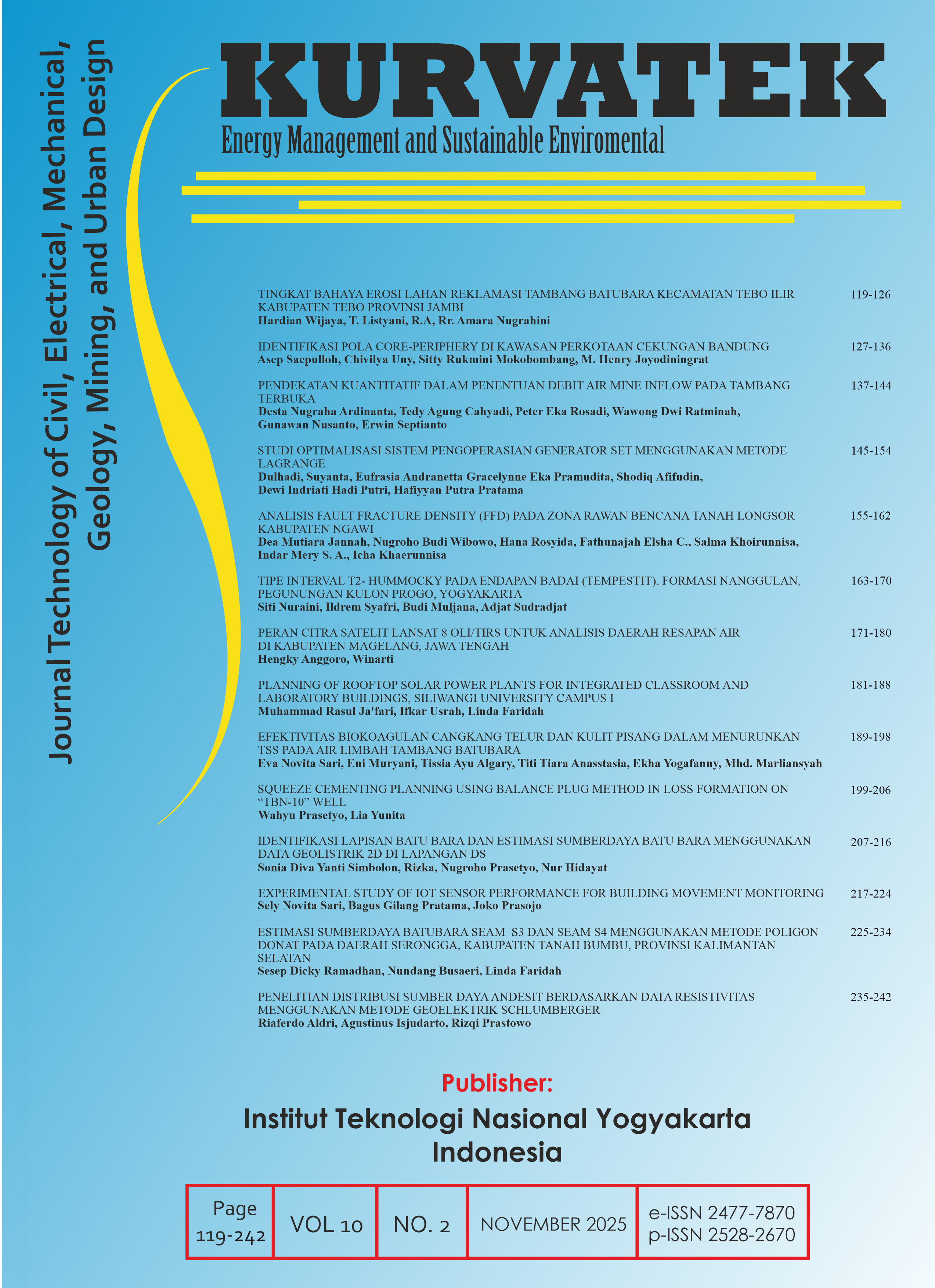
HUMMOCKY INTERVAL IN STORM DEPOSITS (TEMPESTITE), NANGGULAN FORMATION, KULON PROGO MOUNTAINS, YOGYAKARTA
DOI:
https://doi.org/10.33579/krvtk.v10i2.5800Keywords:
Hummocky, tempestite, storm, currentAbstract
The composition of storm deposit layers (tempestites) is described as a normal sedimentary deposit or fining upward-deposit, divided into 3 units: the lower part, the middle part, and the upper part. The lower part is characterized by coarse clastics, the middle part known as T2 consists of a combination of hummocky and swalley layers containing finer clastics with good sorting. The upper part shows deposition of layering in increasingly calm current conditions with fine clastics: clay. The T2 interval is often considered a characteristic of turbidite deposit models due to gravity flow. However, on the other hand, the nature of storm-induced currents (hummocky-swalley) is more varied due to the role of 3 controlling currents: oscillatory currents, bottom currents, and combined currents. This study will investigate the characteristics of storm interval T2 (tempestites) in the Nanggulan Formation. The method applied is to generate stratigraphic sections for 3 sections (Kali Clumprit, Watupuru, and Songgo), age correlation and of paleocurrents analysis. Storm deposits are found in the Middle Eocene-aged Nanggulan Formation, showing a polymodal direction with opposing and branching within T2 interval. This pattern reflects two opposing directions: bottom currents and storm oscillatory currents. On the other hand, a combination current emerges, branching off from the main current pattern. The T2 Watupuru layer consists of overlapping hummocky layers that extend in a northwestward direction, indicating an ancient coastal or land area.
Downloads
References
P. M. Myrow, L. Tice, B. Archuleta, B. Clark, J. F. Taylor, and R. L. Ripperdan, “Flat‐Pebble Conglomerate: Its Multiple Origins and Relationship to Metre‐Scale Depositional Cycles,” Sedimentology, vol. 51, no. 5, pp. 973-996, 2004.
H.F.L. William, “Shell Bed Tempestites in the Chenier Plain of Louisiana: late Holocene example and modern analogue,” Journal of Quaternary Science, vol. 26, no. 2, pp. 199–206, 2011.
G. Einsele, “Marine Depositional Events Controlled by Sediment Supply and Sea-Level Changes,” Geologische Rundschau, vol. 82, no. 2, pp. 173-184, 1993.
L. Pomar, J. M. Molina, P. A. Ruiz-Ortiz, and J. A. Vera, “Storms in the Deep: Tempestite-and Beach-like Deposits in Pelagic Sequences (Jurassic, Subbetic, South of Spain),” Marine and Petroleum Geology, vol.107, pp. 365-381, 2019.
S. A. Grundvåg, M. E. Jelby, S. Olaussen, and K. K. Śliwińska, “The Role of Shelf Morphology on Storm‐Bed Variability and Stratigraphic Architecture, Lower Cretaceous, Svalbard,” Sedimentology, vol. 68, no. 1, pp. 196-237, 2021.
N. A. Franco, M. A. P. Peña, R. S. Silva, C. M. Ojeda, G. V. M. Edith, R. R. Ramiro, and V. M. C. Valois, “First Report of Tempestites in the Lower Tithonian Subsurface in Southern Mexico: Sedimentary Interpretation and Exploration Perspectives,” Gulf Coast Association of Geological Societies Transactions, vol. 61, pp. 523–533, 2011.
B. Legler, G. J. Hampson, C. A. L. Jackson, H. D. Johnson, B. Y. G. Massart, M. Sarginson, and R. Ravnås, “Facies Relationships and Stratigraphic Architecture of Distal, Mixed Tide- and Wave-Influenced Deltaic Deposits: Lower Sego Sandstone, Western Colorado, U.S.A.,” Journal of Sedimentary Research, vol. 84, no. 8, pp. 605–625, 2014.
S. Nuraini, I. Syafri, B. Muljana, and A. Sudradjat, “Ichnofossil of Nanggulan Deltaic System: Case Study of Watupuru Cross Section in Kulon Progo, Central Java, Indonesia,” Indonesian Journal on Geoscience, vol. 11, no. 2, pp. 295-312, 2024.
P. M. Myrow, W. Fischer, and J. W. Goodge, “Wave-Modified Turbidites: Combined-Flow Shoreline and Shelf Deposits, Cambrian, Antarctica,” Journal of Sedimentary research, vol. 72, no. 5, pp. 641-656, 2002.
W. Rahardjo, Sukandarrumidi, and H. M. D. Rosidi, Peta Geologi Yogyakarta, Jawa, skala 1:100,000, Pusat Penelitian dan Pengembangan Geologi, Bandung. 1995.
D. A. Leckie and L. F. Krystinik, “Is there Evidence for Geostrophic Currents Preserved in the Sedimentary Record of Inner to Middle-Shelf Deposits,” Journal of Sedimentary Research, vol. 59, no. 5, pp. 862-870, 1989.
J. W. Snedden and D. J. Swift, “Is There Evidence for Geostrophic Currents, Preserved in the Sedimentary Record of Inner-to Middle-shelf Deposits”, Discussion, Journal of Sedimentary Research, vol. 61, no. 1, 1991.
Downloads
Published
How to Cite
Issue
Section
License
Copyright (c) 2025 siti Nuraini, Ildrem Syafri, Budi Muljana, Adjat Sudradjat

This work is licensed under a Creative Commons Attribution-ShareAlike 4.0 International License.
This journal provides immediate open access to its content on the principle that making research freely available to the public supports a greater global exchange of knowledge.
All articles published Open Access will be immediately and permanently free for everyone to read and download. We are continuously working with our author communities to select the best choice of license options, currently being defined for this journal as follows:
• Creative Commons Attribution-ShareAlike (CC BY-SA)

This work is licensed under a Creative Commons Attribution-ShareAlike 4.0 International License.