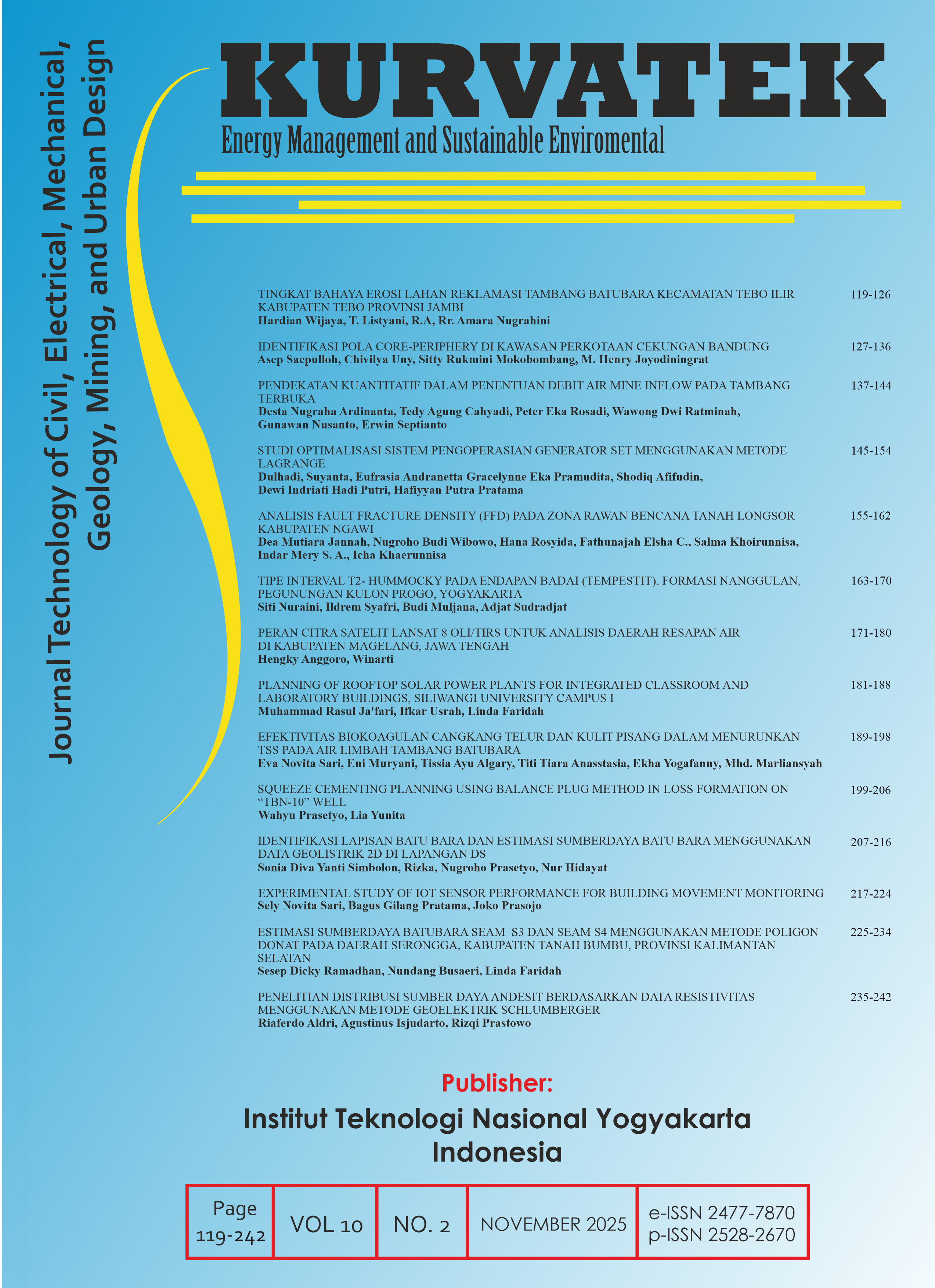
IDENTIFIKASI POLA CORE-PERIPHERY DI KAWASAN PERKOTAAN CEKUNGAN BANDUNG
DOI:
https://doi.org/10.33579/krvtk.v10i2.5708Kata Kunci:
Kawasan Cekungan Bandung, Transformasi Wilayah, Weighted Overlay, Spatial Autocorrelation, Core-PeripheryAbstrak
Penelitian ini mengidentifikasi pola core-periphery dan distribusi kawasan inti-periphery di Kawasan Perkotaan Cekungan Bandung (KPCB), meliputi Kota Bandung, Cimahi, Kabupaten Bandung, Bandung Barat, dan sebagian Sumedang. Metode analisis mencakup Rank Spearman, Weighted Overlay, dan analisis statistik-spasial menggunakan data PODES 2018 dan citra satelit. Hasil Rank Spearman menunjukkan Kepadatan Penduduk memiliki korelasi terkuat (bobot 40%), diikuti Sumber Penghasilan Utama (30%), Penggunaan Lahan (20%), dan Kemiringan Lereng (10%). Analisis Weighted Overlay mengungkap dominasi kawasan core di timur dan utara, serta periphery di selatan dan barat, dipengaruhi kepadatan penduduk, infrastruktur, dan permukiman. Autokorelasi spasial menunjukkan pola klaster (z-score >2,58; Indeks Moran’s 0,197). Cluster & Outlier Analysis mengonfirmasi klaster core terpusat di Bandung dan Cimahi dengan ekspansi ke timur, utara, dan selatan, sementara periphery dominan di barat. Hasil penelitian sejalan dengan Perpres No 45/2018 yang menetapkan Bandung dan Cimahi sebagai inti perkotaan dengan potensi ekspansi ke sekitarnya. Pola ini mencerminkan perkembangan terstruktur dengan kesenjangan akses sumber daya antara core dan periphery.
Unduhan
Referensi
R. D. W. Putra and W. Salim, “Struktur Ruang Wilayah Gerbangkertosusila Berdasarkan Teori Pusat-Pinggiran: Sebuah Kajian,” Tataloka, vol. 24, no. 3, pp. 186–201, 2022, doi: 10.14710/tataloka.24.3.186-201.
E. Rustiadi and Junaidi, “Transmigrasi dan Pengembangan Wilayah,” Jakarta, 2011.
Presiden Republik Indonesia, “Peraturan Presiden Republik Indonesia Nomor 45 ahun 2018 tentang Rencana Tata Ruang Kawasan Perkotaan Cekungan Bandung.” 2018.
L. N. Fuadina, E. Rustiadi, and A. E. Pravitasari, “Analisis Faktor-Faktor yang Mempengaruhi Urban Sprawl di Kawasan Cekungan Bandung,” Tataloka, vol. 23, no. 1, pp. 105–114, 2021, doi: 10.14710/tataloka.23.1.105-114.
H. Winarso, D. Hudalah, and T. Firman, “Peri-Urban Transformation in the Jakarta Metropolitan Area,” Habitat Int., vol. 49, pp. 221–229, 2015, doi: 10.1016/j.habitatint.2015.05.024.
D. Hudalah and T. Firman, “Beyond Property: Industrial Estates and Post-Suburban Transformation in Jakarta Metropolitan Region,” Cities, vol. 29, no. 1, pp. 40–48, 2012, doi: 10.1016/j.cities.2011.07.003.
I. Kustiwan and A. Ladimananda, “Pemodelan Dinamika Perkembangan Perkotaan dan Daya Dukung Lahan di Kawasan Cekungan Bandung,” Tataloka, vol. 14, no. 2, pp. 98–112, 2012, [Online]. Available: https://doi.org/10.14710/tataloka.14.2.98-112
M. Mariš, “Effect of the Centrifugal and Centripetal Effects in Core Versus (SEMI) Periphery in Central Europe Countries,” Acta Univ. Agric. Silvic. Mendelianae Brun., vol. 64, no. 3, pp. 993–1000, 2016, doi: 10.11118/actaun201664030993.
M. E. Singer, A. L. Cohen-Zada, and K. Martens, “Core Versus Periphery: Examining the Spatial Patterns of Insufficient Accessibility in U.S. Metropolitan Areas,” J. Transp. Geogr., vol. 100, no. September 2021, p. 103321, 2022, doi: 10.1016/j.jtrangeo.2022.103321.
J. L. Love, “Raúl Prebisch and the Origins of the Doctrine of Unequal Exchange,” Lat. Am. Res. Rev., vol. 15, no. 3, pp. 45–72, Jan. 1980, [Online]. Available: http://www.jstor.org/stable/2502991
Pan Geography, “Core-Periphery Model by Friedman - Pan Geography.” Accessed: Jan. 22, 2025. [Online]. Available: https://pangeography.com/core-periphery-model-by-friedman/
F. Perroux, “Growth Poles. Economic Space: Theory and Applications,” Q. J. Econ., vol. 64, pp. 89–104, 1950, doi: https://doi.org/10.2307/1881960.
A. Hirschman, The Strategy of Economic Development. New Haven: Yale University Press, 1958.
D. C. North, “Location Theory and Regional Economic Growth,” J. Polit. Econ., vol. 63, no. 3, pp. 243–258, 1955, doi: 10.1086/257668.
G. Myrdal, “The Drift Towards Regional Economic Inequalities in a Country,” in Economic Theory and Underdeveloped Regions, 1957, pp. 23–38.
A. Klimczuk and M. K. Kochanska, “Core-Periphery Model,” Palgrave Encycl. Glob. Secur. Stud., no. Oktober, 2019, doi: 10.1007/978-3-319-74336-3.
R. Prabandaru and Widodo, “Hubungan Kompetensi dengan Kinerja Pamong Belajar pada Program Pendidikan Kesetaraan Paket B di SKB Gresik,” J+PLUS JurnalMahasiswa Pendidik. Luar Sekol., vol. 11, no. 2, p. 105, 2022.
A. D. Hapsari and B. U. Aulia, “Tipologi Wilayah Peri Urban Kabupaten Sidoarjo Berdasarkan Aspek Fisik, Sosial, dan Ekonomi,” J. Tek. ITS, vol. 7, no. 2, 2019, doi: 10.12962/j23373539.v7i2.34248.
S. Nurhayati, Kuswanto, and M. Syafei, “Geo Visualisasi Penentuan Lokasi Tempat Pembuangan Akhir ( Tpa ) Sampah Di Kabupaten Banyumas,” J. Kesmas Indones., vol. 14, no. 1, pp. 24–49, 2022.
F. Ukhti, Z. K. Manurung, and M. D. Mahendra, “Perbandingan Teknik Boolean dengan Weighted Overlay dalam Analisis Potensi Longsor di Banjarmasin,” J. Geosains dan Remote Sens., vol. 2, no. 1, pp. 25–32, 2021, doi: 10.23960/jgrs.2021.v2i1.53.
D. Wu, Y. Wu, X. Ni, Y. Sun, and R. Ma, “The Location and Built Environment of Cultural and Creative Industry in Hangzhou, China: A Spatial Entropy Weight Overlay Method Based on Multi-Source Data,” Land, vol. 11, no. 10, 2022, doi: 10.3390/land11101695.
A. Lutfi, M. K. Aidid, and S. Sudarmin, “Identifikasi Autokorelasi Spasial Angka Partisipasi Sekolah di Provinsi Sulawesi Selatan Menggunakan Indeks Moran,” J. Stat. Its Appl. Teach. Res., vol. 1, no. 2, pp. 1–8, 2019, [Online]. Available: https://doi.org/10.35580/variansi.v1i2.9354
J. Benedek, “Spatial Differentiation and Core-Periphery Structures in Romania,” East. J. Eur. Stud., no. 1, pp. 49–61, 2015.
Z. A. Fitri, “Indeks Moran’s I: Pengertian, Kegunaan, Keterbatasan | by Zahra Annisa Fitri | Rekayasa Data Spasial,” Medium. Accessed: May 24, 2024. [Online]. Available: https://rekayasadata.co.uk/indeks-morans-i-pengertian-kegunaan-keterbatasan-73e9cae06831
M. Cucuringu, P. Rombach, S. H. Lee, and M. A. Porter, “Detection of Core–Periphery Structure in Networks using Spectral Methods and Geodesic Paths,” Eur. J. Appl. Math., vol. 27, no. 6, pp. 846–887, 2016, doi: DOI: 10.1017/S095679251600022X.
S. H. Lee, M. Cucuringu, and M. A. Porter, “Density-based and transport-based core-periphery structures in networks,” Phys. Rev. E, vol. 89, no. 3, p. 32810, Mar. 2014, doi: 10.1103/PhysRevE.89.032810.
##submission.downloads##
Diterbitkan
Cara Mengutip
Terbitan
Bagian
Lisensi
Hak Cipta (c) 2025 Asep Saepulloh, Chivilya Uny, Sitty Rukmini Mokobombang, M. Henry Joyodiningrat

Artikel ini berlisensiCreative Commons Attribution-ShareAlike 4.0 International License.
This journal provides immediate open access to its content on the principle that making research freely available to the public supports a greater global exchange of knowledge.
All articles published Open Access will be immediately and permanently free for everyone to read and download. We are continuously working with our author communities to select the best choice of license options, currently being defined for this journal as follows:
• Creative Commons Attribution-ShareAlike (CC BY-SA)

This work is licensed under a Creative Commons Attribution-ShareAlike 4.0 International License.