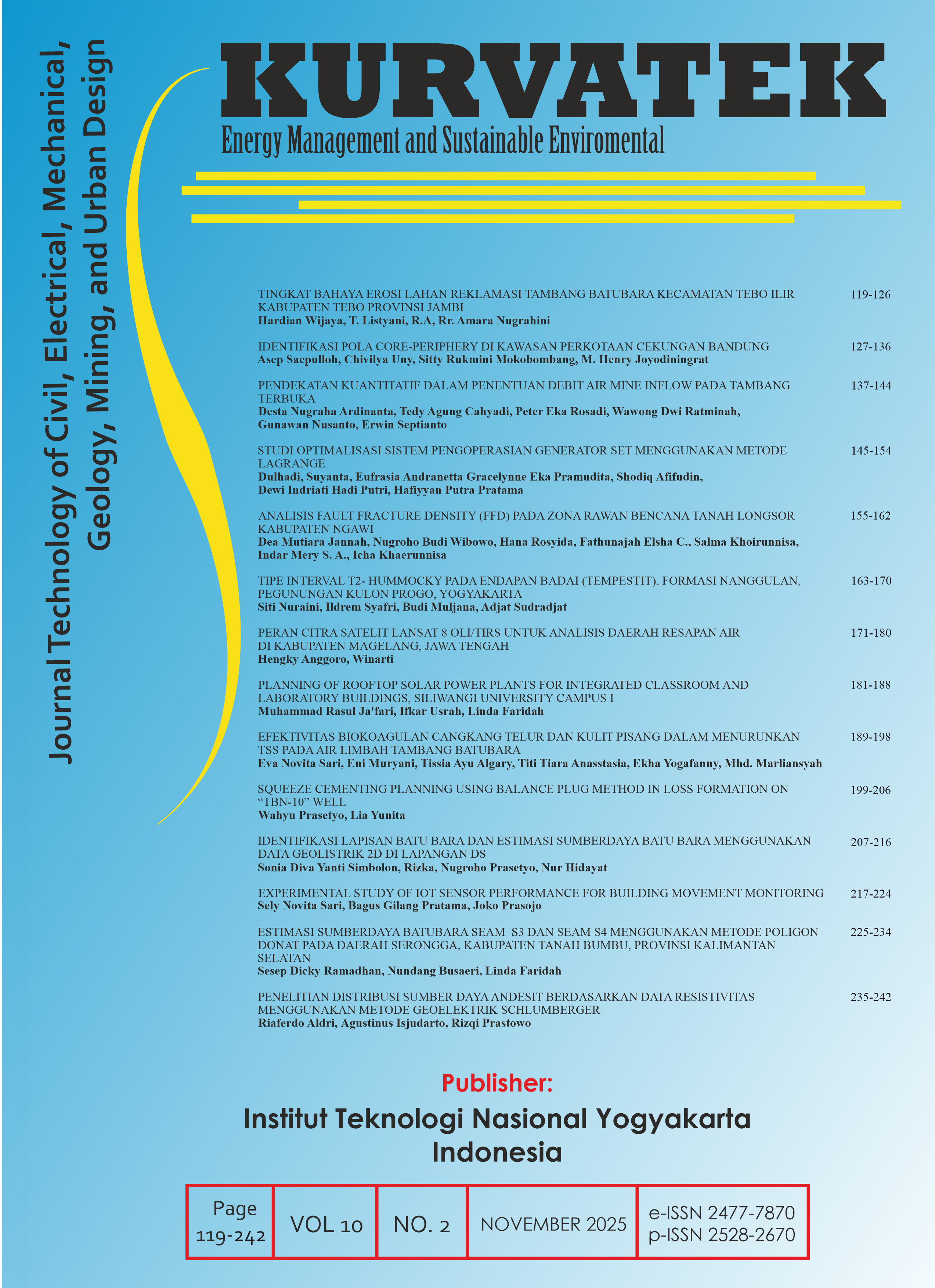
SQUEEZE CEMENTING PLANNING USING BALANCE PLUG METHOD IN LOSS FORMATION ON “TBN-10”
DOI:
https://doi.org/10.33579/krvtk.v10i2.6246Kata Kunci:
Balance, Loss, Squeeze , CementingAbstrak
The TBN-10 well in the subang field is a production well that has experienced a decline in productivity, so it was decided to close the perforation zone in layer 9C using the squeeze cementing method and open a new perforation in layer 9D. This work faces challenges in the form of a loss circulation zone in the baturaja formation, so it is necessary to plan the appropriate cement method and composition. The squeeze cementing method is carried out using the balance plug method, accompanied by the selection of class G cement and special additives such as BAF-14L, BAR-19L, BAL-22L, BAG-17L, and BAF-26L to overcome high pressure conditions, high temperatures, and potential gas disturbances and fluid loss. The calculation of slurry volume, water head, water behind, displacement, and slurry specifications was carried out in detail resulting in a slurry requirement of 15.10 bbl. Laboratory test results showed a thickening time value of 4 hours 29 minutes at a consistency of 100 Bc and a compressive strength of 623 psi in 24 hours. Field evaluation showed that the cementing work successfully formed good isolation on the old perforation zone and allowed the opening of a new, more productive zone. This work successfully repaired the well integrity and became the basis for a workover strategy with a target of significantly increasing production from more economical layers.
Unduhan
Referensi
F. Azzahra, Planning Squeeze Cementing on AZR-26 Well TAF-3.1 Layer. Institut Technology Sains Bandung, 2023.
R. Abdullah and E. Prastio, “Analisa Pekerjaan Squeeze Cementing dengan Metode Balance Plug Berdasarkan Data CBL & VDL pada Sumur “GZ” Lapangan “BHARA”,” Jurnal Offshore: Oil, Production Facilities and Renewable Energy,vol. 6, no. 1, pp. 21-28, 2022.
R. Rubiandini, Teknik Operasi Pemboran. Bandung: Penerbit ITB, 2000.
A. Priambodo, C. Julianto, M. R. Nugroho, and H. Tulloh, “Studi Perencanaan dan Pelaksanaan Squeeze Cementing Metode Bradenhead Squeeze untuk Water Shut Off pada Sumur Minyak dengan Water Cut Tinggi,” In Prosiding Seminar Nasional Sains dan Teknologi Terapan, vol. 1, no. 1, pp. 403-410, September 2020.
F. Firdaus, “Evaluasi Pekerjaan Squeeze Cementing dengan Metode Hesitate pada Sumur Minyak,” Other thesis, Universitas Islam Riau, 2021.
API RP 10B-2, Recommended Practice for Testing Well Cements, 2013.
Ricardo Ricci, “Analisis Squeze Cementing dengna Menggunakan Metode Balance Plug pada Formation Loss di Lapangan RC Sumur X,” Universitas Islam Riau, 2019.
F. Fitrianti, “Analisis Kualitas Bonding Cement di Zona Produktif Sumur BA 147 Menggunakan Ultra Sonic Imager Tool (USIT) Log di Lapangan BOB PT Bumi Siak Pusako-Pertamina Hulu,” Journal of Earth Energy Engineering, vol. 4, no. 2, pp. 29-43, 2015.
E. Prasetyo, T. Arief, and U. A. Prabu, “Perencanaan Squeeze Cementing Metode Balance Plug pada Sumur ‘X’ dan Sumur ‘Y’ di Lapangan Ogan PT. Pertamina Ep Asset 2 Prabumulih,” Jurnal Ilmu Teknik Sriwijaya, pp. 1-9, 2019.
W. Oktrayani, “Desain Perencanaan Aplikasi Squeeze Cementing dengan Menggunakan Hydraulic Workover Unit Snubbing 150K dengan Metode Arrow Set Packer,” Doctoral dissertation, Universitas Islam Riau, 2022.
A. K. Ali and M. Ali, “Carbonate Permeable Zone Cementing Practices and Challenges,” In SPE Gas & Oil Technology Showcase and Conference (p. D031S040R005). SPE, 2023.
##submission.downloads##
Diterbitkan
Cara Mengutip
Terbitan
Bagian
Lisensi
Hak Cipta (c) 2025 Wahyu Prasetyo, Lia Yunita

Artikel ini berlisensiCreative Commons Attribution-ShareAlike 4.0 International License.
This journal provides immediate open access to its content on the principle that making research freely available to the public supports a greater global exchange of knowledge.
All articles published Open Access will be immediately and permanently free for everyone to read and download. We are continuously working with our author communities to select the best choice of license options, currently being defined for this journal as follows:
• Creative Commons Attribution-ShareAlike (CC BY-SA)

This work is licensed under a Creative Commons Attribution-ShareAlike 4.0 International License.