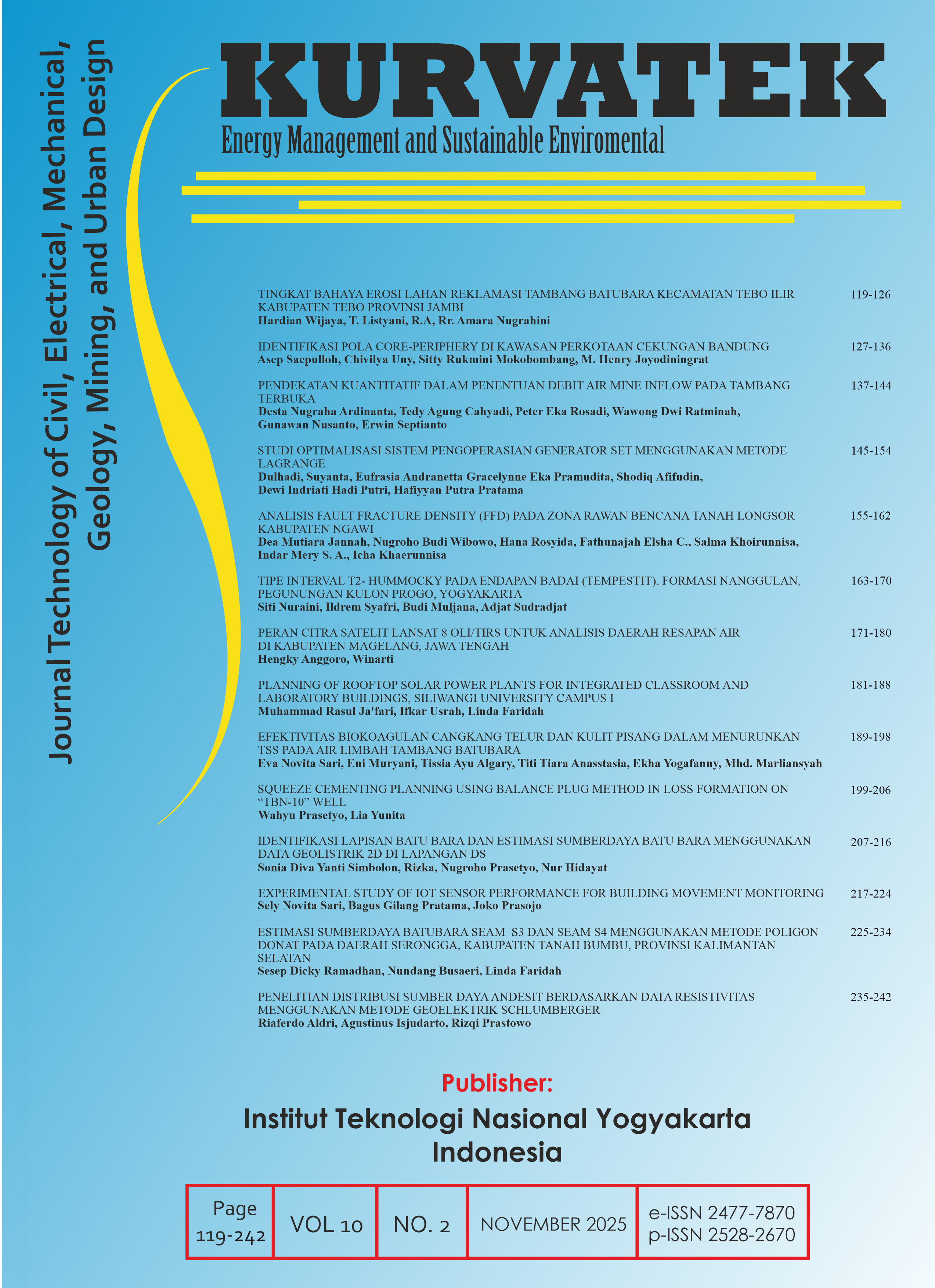
PENELITIAN DISTRIBUSI SUMBER DAYA ANDESIT BERDASARKAN DATA RESISTIVITAS MENGGUNAKAN METODE GEOELEKTRIK SCHLUMBERGER
DOI:
https://doi.org/10.33579/krvtk.v10i2.6408Kata Kunci:
Geolistrik, Schlumberger, Andesit, Resistivitas, Bendungan.Abstrak
Penelitian ini bertujuan untuk mengidentifikasi sebaran batuan andesit di Kecamatan Bener, Kabupaten Purworejo, Jawa Tengah, menggunakan metode geolistrik konfigurasi Schlumberger. Sebanyak 37 titik pengukuran dilakukan dengan bentangan kabel 200 meter untuk memperoleh data tahanan jenis bawah permukaan. Hasil inversi resistivitas menunjukkan nilai berkisar diatas 900 Ωm yang menandakan keberadaan batuan andesit segar dengan kondisi fisik padat dan belum mengalami pelapukan. Model 3D memperlihatkan sebaran andesit yang dominan pada arah baratlaut–tenggara dengan kedalaman antara 0,1 hingga 0,4 km dari permukaan. Persebaran ini berasosiasi dengan struktur vulkanik Formasi Andesit Tua yang berkembang di wilayah tersebut. Secara umum, hasil penelitian menunjukkan bahwa metode geolistrik efektif untuk memetakan distribusi batuan beku bawah permukaan dan memberikan informasi geologi yang penting bagi perencanaan pemanfaatan sumber daya alam di Kecamatan Bener.
Unduhan
Referensi
N. I. Setiawan, “Geochemical Characteristics of Metamorphic Rocks from South Sulawesi, Central Java, South and West Kalimantan in Indonesia,” Asean Eng. J., 2014.
B. Y. Horasan and A. Öztürk, “Features of Andesites Used in Buildings Around İncesu (Seydişehir) Region,” J. Inst. Sci. Technol., vol. 11, no. 3, pp. 2079–2090, 2021.
A. Khan, R. Umar, and H. H. Khan, “Significance of silica in identifying the processes affecting groundwater chemistry in parts of Kali watershed, Central Ganga Plain, India,” Appl. Water Sci., vol. 5, no. 1, pp. 65–72, 2015.
M. H. Loke and R. D. Barker, “Rapid least‐squares inversion of apparent resistivity pseudosections by a quasi‐Newton method1,” Geophys. Prospect., vol. 44, no. 1, pp. 131–152, 1996.
W.M. Telford, L. P. Geldart, and R. E. Sheriff, Applide Geophysics. Cambridge: Cambridge University Press, 1990.
X. Jia, L. Yang, L. Yulong, and Z. Lianzhi, “Application of the high-density resistivity method in detecting a mined-out area of a quarry in Xiangtan City, Hunan Province,” Front. Environ. Sci., vol. 10, p. 1068956, 2022.
W. Rahardjo, Sukandarrumidi, and R. H.M.D, Peta Geologi Lembar Yogyakarta, Jawa, skala 1 : 100.000, cetakan ke 3. Bandung, 2012.
P. Kearey, M. Brooks, and I. Hill, An introduction to geophysical exploration, vol. 4. John Wiley & Sons, 2002.
H. Jayadi, I. U. Meidji, and B. Y. Tang, “Identifying Andesite Rocks Sources Using Geoelectrical Resistivity in Loli, Donggala Regency, Central Sulawesi,” J. Phys. Sci. Eng., vol. 4, no. 2, pp. 45–54, 2019.
R. Prastowo, H. Helmi, O. Trianda, and R. Umam, “Identification of Andesite Resource Potential In Kalirejo Area, Kokap Sub-District, Kulon Progo using Resistivity Method,” Forum Geogr., vol. 35, no. 1, pp. 74–84, 2021, doi: 10.23917/forgeo.v35i1.13507.
H. Purnomo, R. Prastowo, M. H. Hibullah, and S. Pambudi, “Estimasi Sumberdaya Andesit Menggunakan Metode Ordinary Kriging Berdasarkan Pengukuran Geolistrik di PT. Zlaw Group Boyolali, Jawa Tengah,” J. Teknol. Miner. Dan Batubara, vol. 19, no. 1, pp. 1–13, 2023.
D. J. Sasangka, S. Suhardi, D. P. Riyanto, D. Insani, and C. Dwi, “Analisis Kerentanan Lereng Lokasi Pembangunan Bendungan Bener Kabupaten Purworejo,” JGE J. Geofis. Eksplor., vol. 7, no. 3, pp. 238–255, 2021.
A. H. M. K. Zain, K. W. Sadono, and S. P. R. Wardani, “Pengaruh Pelaksanaan Pekerjaan Timbunan terhadap Stabilitas Bendungan Urugan Selama Masa Konstruksi,” J. Tek. Sipil Dan Lingkung., vol. 8, no. 3, pp. 167–176, 2023.
A. M. Juwono, A. Susilo, F. Aprilia, and F. Hisyam, “Study Of Subsurface Conditions Of Southern Cross Road Using The Wenner-Schlumberger Method For Disaster Mitigation,” GEOMATE J., vol. 23, no. 97, pp. 97–105, 2022.
##submission.downloads##
Diterbitkan
Cara Mengutip
Terbitan
Bagian
Lisensi
Hak Cipta (c) 2025 Riaferdo Aldri, Agustinus Isjudarto, Rizqi Prastowo

Artikel ini berlisensiCreative Commons Attribution-ShareAlike 4.0 International License.
This journal provides immediate open access to its content on the principle that making research freely available to the public supports a greater global exchange of knowledge.
All articles published Open Access will be immediately and permanently free for everyone to read and download. We are continuously working with our author communities to select the best choice of license options, currently being defined for this journal as follows:
• Creative Commons Attribution-ShareAlike (CC BY-SA)

This work is licensed under a Creative Commons Attribution-ShareAlike 4.0 International License.