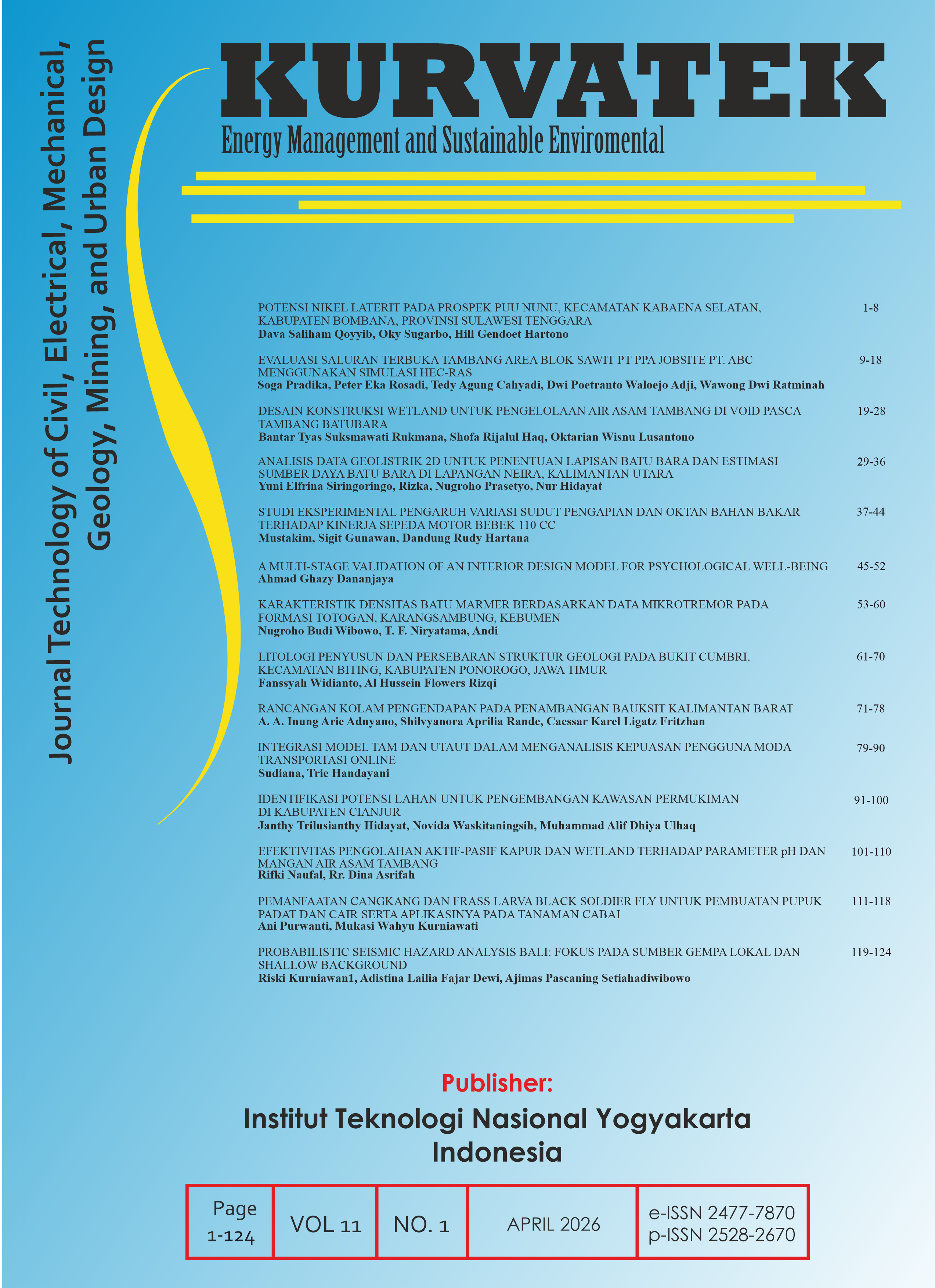
EXPERIMENTAL STUDY ON THE EFFECT OF IGNITION ANGLE VARIATIONS AND FUEL OCTANE NUMBER ON THE PERFORMANCE OF 110CC UNDERBONE MOTORCYCLES
DOI:
https://doi.org/10.33579/krvtk.v11i1.6268Keywords:
Engine Performance, Octane Number , Ignition Timing, Programmable CDIAbstract
Improving motorcycle performance is a primary focus in efforts to enhance energy efficiency. Motorcycle performance is strongly influenced by ignition timing and fuel octane rating, as the standard ignition timing of most motorcycles is designed for RON 88 fuel. This study aims to examine the effect of ignition timing variation using a programmable CDI and different fuel types on the performance of a 110 cc underbone motorcycle engine. The research variables include ignition timing and fuel types with different octane ratings (Pertalite RON 90, Pertamax RON 92 and Pertamax Turbo RON 98). An experimental method was employed by conducting tests on a chassis dynamometer to obtain power and torque data. The results show that adjusting the ignition timing using a programmable CDI and increasing the fuel octane rating significantly improve engine power and torque, particularly at medium and high engine speeds. The highest standard ignition timing—32° before top dead center using regular fuel—produced a maximum power of 7.8 HP at 7500–8000 RPM and a peak torque of 8.41 Nm at 4000 RPM. Meanwhile, with the programmable CDI, the highest power was achieved at an ignition timing of 34° before top dead center on map 2 using Pertamax Turbo (RON 98), generating a maximum power of 8 HP at 7500 RPM and a peak torque of 8.66 Nm at 4500 RPM.
Downloads
References
Syarifudin, A. Suprihadi dan F. L. Sanjaya, “Optimalisasi Kompetensi Motor Bakar Bagi Peserta Didik Teknik Sepeda Motor Kelas Xii “Smk Bina Nusa Slawi”,” Abdimas Unwahas, vol. 5, no. 2, pp. 109-113, Oktober 2020.
J. B. Heywood, Internal Combustion Engine Fundamentals. McGraw-Hill, 1988.
W. W. Pulkrabek, Engineering Fundamentals of The Internal Combustion Engine, 2nd ed., Pearson Prentice Hall, 2004.
Bosch. Automotive Handbook, 6th ed., Robert Bosch GmbH, 2004.
M. N. Fajar, S. Kun, dan I. Sigit, “Studi Eksperimental Penggunaan Capacitor Discharge Ignition (CDI) Rextor Terhadap Performa Motor Bensin 4 Langkah 150 cc,” In SENASTER Seminar Nasional Riset Teknologi Terapan, vol. 3, no. 2 2022.
A. Prasetyo, S. Hadi, dan R. A. Wicaksono, “Pengaruh Pemrograman Sudut Pengapian Terhadap Performa Mesin Sepeda Motor Menggunakan Programmable CDI,” Prosiding Seminar Nasional Teknik Mesin (SENATEK), vol. 5, no. 1, pp. 112–118, 2022.
I. Nurhadi dan T. Sutikno, “Analisis Pengaruh Sudut Pengapian Terhadap Kinerja Mesin Bensin 4 Langkah,” Jurnal Teknik Mesin dan Energi, vol. 9, no. 1, pp. 45–52, 2020.
A. Digdoyo, D. Djamruddin, R. Yulianto, T. Surawan, dan M. Budianto, “Analisa Performance Motor Bensin Silinder 1 Menggunakan CDI Standar dan CDI Racing Dengan Bahan Bakar Pertamax Turbo,” In Proceeding Technology of Renewable Energy and Development Conference vol. 3, no. 1, Agustus 2023.
Suhartoyo, “Pengaruh Penggunaan CDI Unlimiter terhadap Daya dan Torsi Honda Karisma,” Mechonversio: Mechanical Engineering Journal, vol. 5, no. 2, pp. 45-49, Oktober 2022.
Fahrezi, M. Widdy, R. Setiawan, dan R. Hanifi. “Pengaruh Variasi Bahan Bakar dengan Perubahan Sudut Waktu Pembakaran (Ignition Timing) terhadap performa Mesin Sepeda Motor Vario 125 cc,” Jurnal Kajian Teknik Mesin, vol. 8, no. 1, pp. 151-160, 2023.
Mustakim dan S. Gunawan. "Pengaruh Sudut Pengapian Programmable CDI terhadap Performa Daya dan Torsi Mesin Sepeda Motor 110 CC," Jurnal Penelitian Inovatif, vol. 5, no. 3, pp. 2427-2438, 2025
Downloads
Published
How to Cite
Issue
Section
License
Copyright (c) 2026 Mustakim Mustakim, Sigit Gunawan, Dandung Rudy Hartana

This work is licensed under a Creative Commons Attribution-ShareAlike 4.0 International License.
This journal provides immediate open access to its content on the principle that making research freely available to the public supports a greater global exchange of knowledge.
All articles published Open Access will be immediately and permanently free for everyone to read and download. We are continuously working with our author communities to select the best choice of license options, currently being defined for this journal as follows:
• Creative Commons Attribution-ShareAlike (CC BY-SA)

This work is licensed under a Creative Commons Attribution-ShareAlike 4.0 International License.